7 minutes read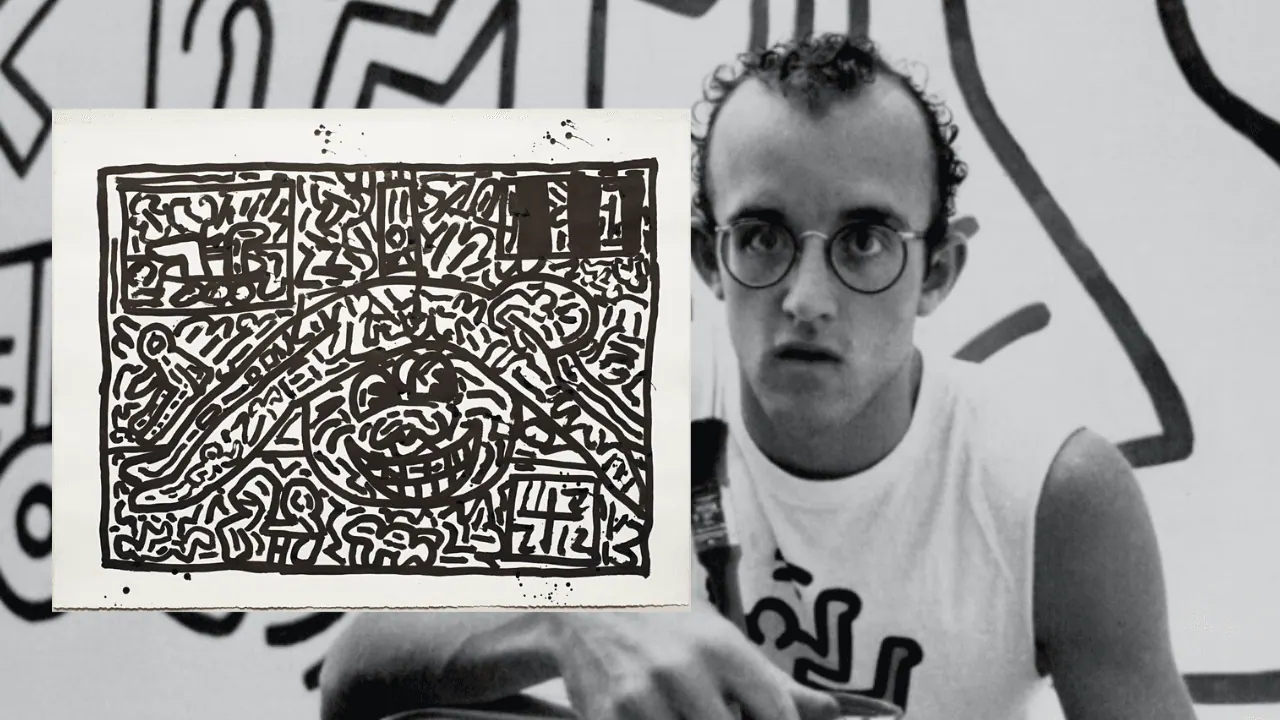
New York, 1981. The subway tunnels are still gray and dirty, but something unexpected begins to appear along the corridors. Stylized figures, black lines drawn freehand, small pulsating worlds that seem to dance under the artificial light. It is Keith Haring, an artist in his early twenties who has arrived from Pittsburgh to experience the ferment of the New York art scene. And as Jean-Michel Basquiat begins to transform walls into visual poetry, Haring chooses blank billboards as the first media for his direct and vibrant language. His black “blackboards”-and then paper, walls, canvases-become the space for a gesture that does not seek aesthetics: it seeks contact, impact, change.
It is in this context that Untitled, 1981, one of his first large-format works on paper, made with a decisive, immediate, primordial black acrylic, was born. The work is a graphic explosion of expressive force, in which Haring’s hand seems more like a nervous reflex than a meditated pictorial act. The figures that inhabit it – stylized bodies, vibrant symbols, dynamic signs – emerge from an immaculate white background like flashes of compressed energy. In those gestures, one senses the urgency to say something, to make one’s voice heard in a rapidly changing world of economic boom, nuclear fear, new civil rights and the first shadows of the AIDS emergency.
Untitled, 1981 is not just a stylistic exercise: it is a manifesto. A necessary act. Haring, a child of pop culture but also deeply influenced by Jung’s spirituality and thought, creates a new language of universally readable icons: radiant children, barking dogs, pyramids, lines of action, and always the human body as the center of the narrative. This work on paper is tangible evidence of the moment when that language takes final form. The pictorial gesture is not corrected or filtered: it is left raw, urgent, direct. An immediately recognizable visual writing, capable of speaking to anyone, without mediation.
The work has an extraordinary provenance: it was first exhibited in 1986 at the University Art Gallery of California State University, San Bernardino, in the exhibition Point of View: Artworks from the Collection of Jeffrey Kerns, and published in the catalog of the same name edited by J. Kerns and M. Kohn. It had previously passed through the Gagosian Gallery in Los Angeles, an absolute reference for contemporary world art. It was later included in the “Contemporary Art Sale” auction held by Phillips de Pury & Company in New York on November 16, 2012 (lot 192), where it was purchased by the current owner. Its presence in an institutional exhibition and publication in an official catalog reinforce its historical and collector’s relevance.
The market has consistently rewarded works from this period: Haring’s works on paper, especially those made between 1981 and 1984, are now among the most coveted by collectors. Its value index has risen more than 220 percent in the past decade. Recent auctions have seen similar works exceed £5 million, as was the case at Sotheby’s in 2017. His work is on permanent display at institutions such as MoMA, the Whitney Museum, the Centre Pompidou, and the Guggenheim Museum, and he has received solo exhibitions at more than 300 venues worldwide, including the Fondation Beyeler and the Palazzo Reale in Milan.
To own Untitled, 1981 is to have in your hands an original, living, pulsating trace of one of the most influential visual languages of the second half of the twentieth century. It means cherishing a precise and unrepeatable moment in the history of urban art, in which art leaves museums and returns to the streets and, from there, redefines the canons of aesthetics and activism. It is a work about the beginning of a revolution, with the clear and unmistakable voice of Keith Haring.New York, 1981. The subway tunnels are still gray and dirty, but something unexpected begins to appear along the corridors. Stylized figures, black lines drawn freehand, small pulsating worlds that seem to dance under the artificial light. It is Keith Haring, an artist in his early twenties who has arrived from Pittsburgh to experience the ferment of the New York art scene. And as Jean-Michel Basquiat begins to transform walls into visual poetry, Haring chooses blank billboards as the first media for his direct and vibrant language. His black “blackboards”-and then paper, walls, canvases-become the space for a gesture that does not seek aesthetics: it seeks contact, impact, change.
It is in this context that Untitled, 1981, one of his first large-format works on paper, made with a decisive, immediate, primordial black acrylic, was born. The work is a graphic explosion of expressive force, in which Haring’s hand seems more like a nervous reflex than a meditated pictorial act. The figures that inhabit it – stylized bodies, vibrant symbols, dynamic signs – emerge from an immaculate white background like flashes of compressed energy. In those gestures, one senses the urgency to say something, to make one’s voice heard in a rapidly changing world of economic boom, nuclear fear, new civil rights and the first shadows of the AIDS emergency.
Untitled, 1981 is not just a stylistic exercise: it is a manifesto. A necessary act. Haring, a child of pop culture but also deeply influenced by Jung’s spirituality and thought, creates a new language of universally readable icons: radiant children, barking dogs, pyramids, lines of action, and always the human body as the center of the narrative. This work on paper is tangible evidence of the moment when that language takes final form. The pictorial gesture is not corrected or filtered: it is left raw, urgent, direct. An immediately recognizable visual writing, capable of speaking to anyone, without mediation.
The work has an extraordinary provenance: it was first exhibited in 1986 at the University Art Gallery of California State University, San Bernardino, in the exhibition Point of View: Artworks from the Collection of Jeffrey Kerns, and published in the catalog of the same name edited by J. Kerns and M. Kohn. It had previously passed through the Gagosian Gallery in Los Angeles, an absolute reference for contemporary world art. It was later included in the “Contemporary Art Sale” auction held by Phillips de Pury & Company in New York on November 16, 2012 (lot 192), where it was purchased by the current owner. Its presence in an institutional exhibition and publication in an official catalog reinforce its historical and collector’s relevance.
The market has consistently rewarded works from this period: Haring’s works on paper, especially those made between 1981 and 1984, are now among the most coveted by collectors. Its value index has risen more than 220 percent in the past decade. Recent auctions have seen similar works exceed £5 million, as was the case at Sotheby’s in 2017. His work is on permanent display at institutions such as MoMA, the Whitney Museum, the Centre Pompidou, and the Guggenheim Museum, and he has received solo exhibitions at more than 300 venues worldwide, including the Fondation Beyeler and the Palazzo Reale in Milan.
To own Untitled, 1981 is to have in your hands an original, living, pulsating trace of one of the most influential visual languages of the second half of the twentieth century. It means cherishing a precise and unrepeatable moment in the history of urban art, in which art leaves museums and returns to the streets and, from there, redefines the canons of aesthetics and activism. It is a work about the beginning of a revolution, with the clear and unmistakable voice of Keith Haring.
Untitled, 1981 di Keith Haring è stata caricata su Collecto con una quotazione di 261.400 €. In meno di 20 minuti, tutte le quote sono state vendute. Un risultato che conferma non solo l’importanza storica e collezionistica dell’opera, ma anche la forza della community Collecto nel riconoscere e valorizzare capolavori di assoluto rilievo internazionale.